Your commercial floors have a lot to handle: heavy traffic, chemical spills, safety requirements, and the need to look presentable while doing it all. That's a lot to ask from any surface.
That's why so many commercial and industrial spaces turn to epoxy flooring.
From warehouses and manufacturing plants to commercial kitchens, schools, and retail spaces, epoxy works across all types of industries because it's durable, low-maintenance, and built for daily use.
In this guide, we'll walk you through the benefits of epoxy for commercial flooring, how it performs across different industries, and the signs your space might need it.
Table of Contents
- The Benefits of Epoxy Flooring for Commercial Spaces
- How Epoxy Flooring Performs Across Different Industries
- Signs Your Commercial Space Needs Epoxy Flooring
The Benefits of Epoxy Flooring for Commercial Spaces
- Durability: Epoxy bonds directly to concrete and forms a hard, seamless surface that resists moisture and withstands heavy foot traffic, machinery, forklifts, and daily use. When properly installed, it holds up against chipping, peeling, and cracking in ways that paint or vinyl simply don't.
- Chemical and Stain Resistance: Commercial environments deal with many spills, including oils, grease, cleaning agents, food and beverage liquids, and more. Because epoxy is non-porous, these substances sit on the surface rather than soaking into the concrete, making cleanup easier and limiting long-term damage.
- Safety Improvements: Anti-slip additives can be mixed into the epoxy coating to create a textured surface that lowers the risk of slips and falls, even in wet or high-traffic areas. This is especially helpful for workplaces that need to meet OSHA standards or for food-service environments that must meet health code requirements.
- Low Maintenance: The epoxy surface doesn’t trap dust, bacteria, or debris the way grout lines or textured materials can. In most cases, routine cleaning with a mop and a mild cleaner is all that’s needed. No waxing, sealing, or special treatments.
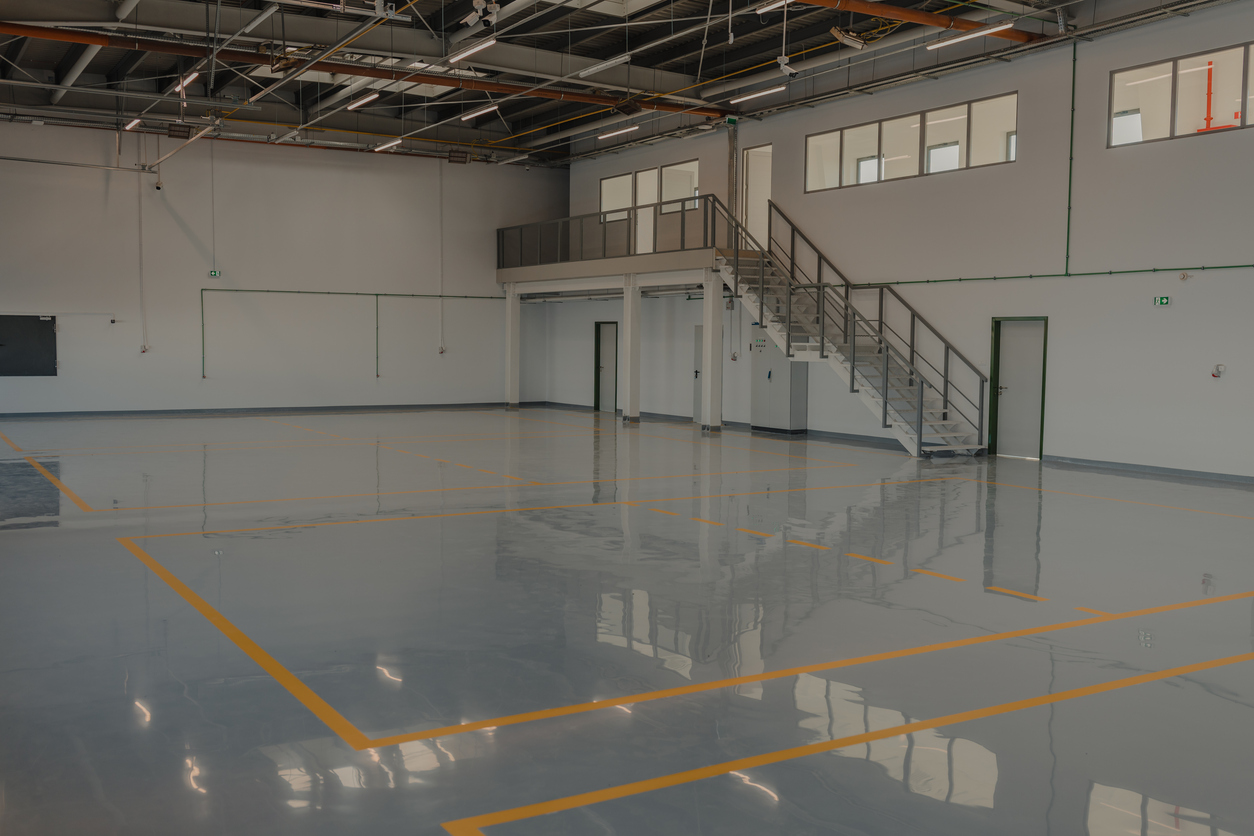
- Light Reflectivity: Lighter-colored epoxy coatings reflect light well, which can noticeably brighten large spaces like warehouses and manufacturing facilities. This can improve visibility for workers and, in some cases, reduce the need for more lighting.
- Long-Term Value: Epoxy's durability tends to reduce the need for repairs, replacements, and ongoing maintenance over time. For businesses watching their operating costs, that's a number worth paying attention to.
- Customizable Appearance: Epoxy comes in a wide range of colors, flake blends, and finishes. It also makes it easy to create color-coded safety zones, designate work areas, or match your facility's brand standards. For spaces where appearance matters, decorative options like metallic finishes are also available.
How Epoxy Flooring Performs Across Different Industries
Warehouses and Distribution Centers
Warehouses are demanding environments. Forklifts, pallet jacks, heavy loads, and constant foot traffic put a lot of stress on floors every single day.
While concrete is strong, it can dust, stain, and deteriorate over time, which creates both maintenance and safety concerns. Concrete dusting is a common issue in loading dock and warehouse areas, as it creates fine particles that settle on equipment and inventory and can pose a slip hazard on its own.
Adding an epoxy flooring system creates a dense, impact-resistant surface that holds up under the weight of heavy equipment without cracking or degrading. It also seals the concrete, preventing dusting and making the floor easier to keep clean.
How epoxy helps in warehouses and distribution centers:
- Stands up to heavy forklift and vehicle traffic without cracking or degrading.
- Seals the concrete surface, eliminating dust that can affect equipment, inventory, and air quality.
- A high-gloss finish reflects light, improving visibility in large spaces.
- Color-coded zones can designate forklift lanes, walkways, hazard areas, and loading zones.
- Slip-resistant finishes support workplace safety standards.
Commercial Kitchens and Restaurants
Commercial kitchens deal with constant moisture, grease, dropped equipment, strong cleaning chemicals, and strict hygiene requirements, all on the same floor, every single day.
Epoxy works well here because it creates a non-porous surface with no grout lines or gaps where bacteria, grease, or moisture can collect, making it easier to clean and helping maintain the sanitation standards required by health inspections.
It also holds up to the physical demands of a kitchen, heavy use, and frequently dropped items, and it won't break down the way other surfaces can when exposed to strong cleaning chemicals. Anti-slip additives can be added to the topcoat as well, giving your kitchen staff a safer footing when the floor is wet.
How epoxy helps in commercial kitchens and restaurants:
- No grout lines or gaps where bacteria, grease, and moisture can collect.
- Easier to sanitize than tile; helpful for meeting health inspection standards.
- Anti-slip additives provide a safer footing for kitchen staff in wet conditions.
- Resists oil, grease, and cleaning chemicals without breaking down or staining over time.
- Available in finishes that work well visually in front-of-house dining areas too.
Food and Beverage Processing Facilities
Food and beverage processing facilities operate under some of the strictest hygiene and safety standards of any commercial environment.
Floors in these spaces need to be able to handle heavy equipment, constant washdowns, exposure to food acids and processing chemicals, and comply with FDA and USDA requirements, all while staying safe for workers.
Epoxy flooring works well in this environment because it creates a smooth, non-porous surface with no cracks or grout lines where bacteria, moisture, or food particles can build up, which is important for maintaining sanitary conditions and passing facility inspections.
How epoxy helps in food and beverage processing facilities:
- Smooth, non-porous surface prevents bacteria, moisture, and food particles from collecting.
- Withstands frequent heavy washdowns and exposure to food acids and processing chemicals.
- Slip-resistant finishes help keep workers safe in wet processing environments.
- Supports compliance with FDA and USDA sanitation requirements.
- Antimicrobial additives are available for facilities that require an additional layer of contamination protection.
- Color-coded zones can designate processing areas, walkways, and sanitation stations.
Manufacturing and Industrial Plants
Manufacturing environments put flooring through serious wear and tear. Heavy machinery, chemical exposure, constant vibration, and high volumes of foot and vehicle traffic are all part of the daily routine. Flooring that can't hold up to those conditions tends to create larger operational and safety problems over time.
Epoxy’s chemical resistance makes it a practical choice for manufacturing plants and industrial facilities where oils, solvents, and industrial fluids are regularly used. The non-porous surface also makes spill containment and cleanup easier, helping reduce downtime when accidents happen.
It also holds up well to temperature fluctuations that can cause other flooring materials to crack or deteriorate over time, an important consideration in facilities that deal with heat, cold, or rapid temperature changes.
How epoxy helps in manufacturing plants and industrial facilities:
- Resistant to oils, solvents, and industrial fluids.
- Makes spill containment and cleanup faster, reducing downtime.
- Holds up to temperature fluctuations that can cause other flooring materials to crack or deteriorate.
- Light-reflective finish helps brighten large spaces and improve worker visibility.
- Anti-slip finishes help reduce the risk of injury in high-activity areas.
- Color-coded systems can help create clear boundaries between work zones, equipment areas, and emergency exits.
Retail Spaces and Showrooms
In retail, the condition of your space reflects on your business. Worn, stained, or cracked flooring is something customers notice, even if only subconsciously.
Epoxy holds up well to the kind of daily foot traffic retail floors see, and it maintains a clean, polished look without requiring much upkeep. With a wide range of colors and finishes available, it’s easy to create a floor that complements your store’s design, reflects your brand, and creates a welcoming space from the moment customers walk in.
For auto dealerships and product showrooms, the high-gloss finish is also a natural fit. It creates a clean backdrop that lets the products speak for themselves, and holds up to vehicle traffic, tire marks, and oil drips.
How epoxy helps in retail spaces and showrooms:
- Holds up well under heavy daily foot traffic without showing wear quickly.
- Resistant to scuffs, stains, and everyday wear.
- Easy to maintain. Regular mopping is typically all that's needed.
- Wide range of colors and finishes to complement your store’s design or brand.
- High-gloss finish works well in showroom settings and protects against tire marks and oil drips.
Office Buildings
While epoxy isn't the most obvious choice for an office, it's worth considering for certain areas such as lobbies, reception areas, break rooms, hallways, and utility spaces, where you need something durable and easy to keep clean without a lot of ongoing maintenance.
In high-traffic areas like lobbies and entrances, epoxy flooring holds up well to daily foot traffic while keeping a clean, professional look. And for break rooms and restrooms, the non-porous surface is easy to sanitize and doesn't require the regular upkeep that other flooring options typically require, such as vinyl composition tile, which can chip or crack over time and needs regular stripping, waxing, and buffing.
How epoxy helps in office buildings:
- No waxing, resealing, or specialized cleaning needed; a regular mop keeps it in good shape.
- Non-porous surface makes break rooms and restrooms easier to keep clean and hygienic.
- Slip-resistant finishes can be added in entrances and high-traffic areas.
- Wide range of colors and finishes that can be matched to a company's existing aesthetic.
Schools and Educational Facilities
Schools deal with a lot of daily foot traffic, from crowded hallways between classes to busy areas like cafeterias, gyms, and locker rooms. Flooring in these environments needs to hold up to heavy use, frequent cleaning, and safety requirements without becoming a constant maintenance burden.
Epoxy works well in schools because it creates a durable, easy-to-clean surface that holds up over time. Unlike tile, which can trap dirt in grout lines, epoxy creates a smooth, non-porous layer that’s simpler to clean and maintain.
It works particularly well in gymnasiums, hallways, cafeterias, and utility rooms where both durability and hygiene are a priority.
How epoxy helps in schools and educational facilities:
- No waxing, resealing, or specialized cleaning needed. A regular mop keeps it in good shape.
- Anti-slip additives can be added to improve safety for students and staff, especially in areas that get wet, like cafeterias and locker rooms.
- Custom colors, logos, and directional markings can be incorporated directly into the floor for school identity and navigation.
- Holds up well under heavy daily use, reducing the need to repair or replace the floor.
Pharmaceutical and Healthcare Facilities
Hospitals, clinics, medical offices, and pharmaceutical facilities have some of the strictest flooring requirements of any commercial environment. The floor needs to support cleaning protocols, resist exposure to harsh chemicals and biohazards, and stay safe for both patients and staff throughout the day.
In pharmaceutical environments, contamination control is even more important. Labs, cleanrooms, and production areas require flooring that meets higher compliance standards and maintains a sterile environment despite frequent sanitization.
Epoxy's non-porous surface is well-suited to these demands. There's nowhere for contaminants to collect, and it can handle the strong disinfectants used in medical and pharmaceutical environments without breaking down or discoloring over time.
How epoxy helps in healthcare facilities:
- No grout lines or seams where contaminants can collect.
- Stands up to strong disinfectants without breaking down or discoloring.
- Antimicrobial additives are available for environments that require an extra level of sanitation protection.
- Supports stricter contamination-control and compliance requirements for labs and cleanrooms.
- Anti-slip finishes help keep patients and staff safe in high-traffic clinical areas.
Aerospace and Aviation Hangars
Aircraft hangars face a unique combination of flooring challenges: heavy aircraft, ground support equipment, and frequent exposure to jet fuels, hydraulic fluids, and other harsh chemicals that can quickly break down an unprotected concrete surface.
Epoxy holds up well in this environment due to its chemical resistance and ability to withstand heavy impacts. It protects the underlying concrete from the kind of fluid exposure that causes long-term deterioration, while still providing a surface that's easy to clean and maintain between operations.
How epoxy helps in aerospace and aviation hangars:
- Resists jet fuels, hydraulic fluids, and other harsh aviation chemicals that break down bare concrete.
- Dense, impact-resistant surface holds up under the weight of heavy aircraft and ground support equipment.
- Easy to clean; fluid spills can be wiped away without soaking into the floor.
- High-gloss finish improves lighting across large hangar spaces, supporting visibility during maintenance work.
- Slip-resistant finishes help keep ground crews safe in areas prone to fluid spills.
- Color-coded zones can designate aircraft parking areas, maintenance zones, and pedestrian walkways.
Signs Your Commercial Space Needs Epoxy Flooring
Not every facility needs to make a flooring change right away, but there are clear signs that your current floor may no longer be doing its job, and that epoxy could be worth considering.
Here are some of the most common signs:
- Your floor is consistently difficult to clean. If spills soak in, stains won’t come out, or cleaning takes more time and effort than it should, that’s often a sign your current surface isn’t holding up the way it should.
- You’re dealing with visible damage. Cracks, chips, dusting concrete, or areas that are flaking or deteriorating are more than cosmetic issues; they can become safety hazards and get worse over time if left untreated.
- Your space regularly handles chemicals, oils, or solvents. If your floor is absorbing these materials rather than letting them wipe away, it’s not providing the long-term protection your concrete needs.
- Slip-and-fall risk is a concern. If wet conditions, spills, or high-traffic areas create unsafe footing for employees or customers, a slip-resistant coating could make a meaningful difference.
- You need clearer organization in your space. If your facility would benefit from designated lanes, safety zones, or color-coded work areas, epoxy can help in a way most other flooring can’t.
- Maintenance costs are adding up. If you’re frequently patching, sealing, or dealing with floor-related issues, the cumulative cost of upkeep on your current flooring may already exceed what a more durable solution would cost over time.
Upgrade Your Commercial Flooring with GarageExperts
If your floors are cracking, staining, hard to clean, or posing safety concerns, it may be worth considering commercial epoxy flooring.
At GarageExperts®, our Garage FX® epoxy and polyaspartic flooring system is built to handle the demands of commercial and industrial environments. Installed by experienced professionals and backed by a limited lifetime warranty, it’s designed for long-term performance and reliability.
Find your local GarageExperts® and request a free on-site estimate. We’ll help you figure out whether epoxy flooring is the right fit for your space.

[1].2402071149280.jpeg)