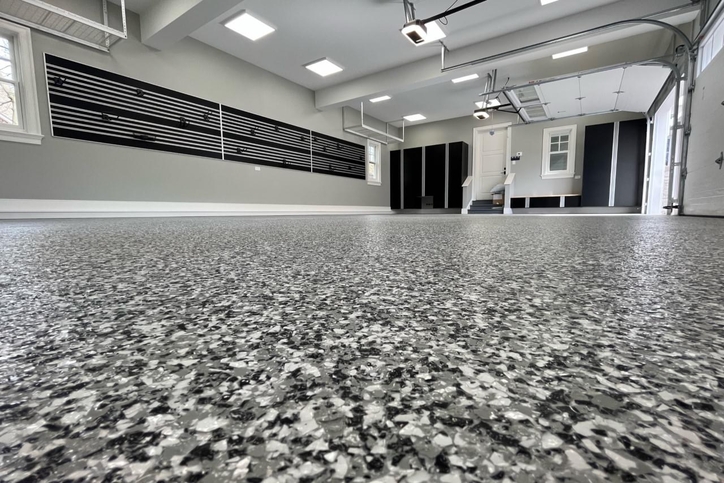
For most residential garages, epoxy performs better over time. Vinyl tile typically costs less upfront and installs faster, but it doesn’t hold up as well under vehicle traffic, temperature swings, and the types of spills a garage floor regularly sees.
In garages used daily and under harsh conditions, epoxy floor coatings are more durable, oil- and chemical-resistant, and tend to last longer, often costing less over time when replacement cycles are factored in. Professional installation, however, is recommended for achieving those long-term results.
Vinyl tile can make sense in certain situations, though. Here’s an honest look at how the two options compare.
Table of Contents
- Epoxy vs Vinyl Tile Flooring: A Direct Comparison
- How Each Garage Flooring Option Works
- Durability of Epoxy vs Vinyl Tile in a Garage
- Epoxy vs Vinyl Tile Cost Over Time
- The Installation Process
- Appearance and Customization
- When Vinyl Tile Flooring Actually Makes Sense
Epoxy vs Vinyl Tile Flooring: A Direct Comparison
How Each Garage Flooring Option Works
Garage Epoxy Flooring
Epoxy floor coating bonds directly to your concrete slab. During installation, the epoxy base fuses with the concrete surface, creating a permanent bond rather than a layer that simply sits on top.
A decorative flake is then applied over the epoxy base, followed by a polyaspartic topcoat that seals the system and creates the finished surface. The result is one continuous floor with no seams, gaps, or edges where damage can start.
Vinyl Garage Flooring
Vinyl tiles are individual pieces installed over existing concrete, either with adhesive backing or interlocking edges. Each tile is a separate unit, which means the floor has seams throughout the entire surface.
Unlike epoxy, vinyl tiles don’t bond chemically to the concrete. They rest on top of it, which is where many long-term performance issues begin.
Durability of Epoxy vs Vinyl Tile in a Garage
Your garage creates conditions that most flooring options aren’t designed for: vehicle weight, seasonal temperature changes, hot tires after driving, oil and brake fluid spills, and pressure washing, to name a few.
How a floor handles these conditions depends on how it’s installed and how it interacts with the concrete beneath it.
Hot Tire Pickup
After you park your car, your tires transfer heat to whatever surface they're resting on. That heat softens the adhesive on vinyl tiles, causing them to lift at the edges or pull up completely when you move the car. Interlocking vinyl tiles avoid the adhesive issue, but they can still shift and separate over time under repeated vehicle weight.
Epoxy floor coatings don’t have this failure point. Because the coating bonds directly to the concrete, there’s no adhesive layer to soften and no individual pieces that can move or lift.
Moisture Beneath the Surface
Concrete is porous, allowing moisture vapor to move through it from beneath the slab, especially in climates with wet winters or humid summers. When moisture gets trapped under vinyl tile, the adhesive can break down, and mold or mildew can develop in the seams between tiles.
Epoxy coatings are installed over properly prepared concrete and create a sealed, continuous surface. This limits moisture intrusion from above and eliminates the gaps where mold and breakdown typically start.
Temperature and Expansion
Both flooring options expand and contract with temperature changes, but vinyl tile tends to move more across extreme temperature swings. In garages that heat up in summer and drop below freezing in winter, that repeated movement can wear down seams, cause tiles to separate, or create uneven areas over time.
Epoxy coatings move with the concrete itself. Because the system is bonded to the slab, there are no seams or edges to shift, making it more stable through temperature swings.
Epoxy vs Vinyl Tile Cost Over Time
Vinyl tile is the more affordable option upfront. You can pick up basic interlocking tiles at most home improvement stores for a fraction of the cost of a professionally installed epoxy floor. That price difference is real, and in some situations, it makes sense.
The long-term costs tell a different story. Tiles that lift, crack, or separate need to be repaired or replaced. If moisture gets underneath the floor, the entire installation may need to be removed. In garages with regular vehicle traffic and temperature swings, many vinyl tile floors can require partial or full replacement within 5 to 10 years.
A properly installed epoxy floor coating is built for those conditions. Because it bonds directly to the concrete, it holds up to daily use, temperature changes, and chemical spills without the same wear and replacement cycle. With basic maintenance, a professional epoxy system can last 20 years or more, making it the more cost-effective option over time.
The Installation Process
Vinyl Tile Flooring
Vinyl tile is designed with DIY installation in mind. You can pick it up at most home improvement stores and complete a basic install in an afternoon. That accessibility is helpful in certain situations, especially for low-traffic or temporary spaces.
However, ease of installation doesn’t always translate to long-term performance in a garage. Proper concrete preparation still plays a major role in how well any floor holds up. Tiles installed over dust, moisture, or an unprepared surface are more likely to shift, lift, or fail prematurely.
Epoxy Flooring
Some homeowners explore DIY epoxy kits as a weekend project, since they’re widely available and seem straightforward at first glance. While these kits can work in very light-use situations, they often fall short in a garage environment where surface prep and installation conditions matter more than the product itself.
That’s where professional installation makes a major difference.
Professional epoxy installation starts with machine-based preparation of the concrete. This process opens the concrete's pores and removes contaminants, allowing the coating to bond properly to the surface.
That preparation is what creates a permanent bond between the epoxy system and the slab. It’s also why professionally installed systems perform more consistently over time: DIY failures are usually tied to incomplete or rushed surface preparation, not the coating itself.
With a professional installer such as GarageExperts®, the process can be efficient, with installation often completed in as little as a day, including surface preparation and the final polyaspartic topcoat. Plus, every installation is backed by a limited lifetime warranty.
Appearance and Customization
Vinyl tile can come in a wide range of design options, including patterns that mimic wood grain, stone, and checkerboard layouts. For homeowners focused primarily on aesthetics, that variety can be an advantage.
Epoxy flooring systems can also offer a high level of customization. Decorative flake blends and color options can be combined in different ways to create a finish that fits the look of your garage, whether you prefer something subtle, bold, or more natural.
Because the system is applied as a continuous surface, the final result doesn’t include tile lines, grout, or repeating grid patterns, just a seamless floor finish. The topcoat used in professional epoxy systems is designed to maintain its gloss and appearance through regular cleaning without the need for waxing or additional sealers.
When Vinyl Tile Flooring Actually Makes Sense
Vinyl tile can be a practical option in a few specific situations.
- If you’re renting and can’t make permanent changes to the floor, interlocking tiles offer flexibility since they can be removed and taken with you.
- If your garage is used mainly as a home gym or hobby space with no vehicle traffic, durability concerns are less of a factor.
- If budget is the main constraint right now, vinyl tile can serve as a short-term solution while you plan for a more permanent upgrade later.
For garages that regularly park vehicles, experience temperature swings, or are exposed to fluids, vinyl tile typically requires more maintenance and earlier replacement compared to a bonded epoxy floor coating.
Need Durable, Long-Term Garage Flooring? Get Your Free Estimate with GarageExperts® Today
If you’re looking for a permanent garage flooring solution, our Garage FX® system is designed specifically for that environment. It combines a high-performance epoxy base with a polyaspartic topcoat to create a durable, seamless surface that’s bright, easy to clean, and built to last. With 140+ colors and finish options, you can customize the look to match your home and personal style.
Contact your local GarageExperts® to get your free on-site estimate today. Our team will assess your concrete, walk you through the process, and help you choose the right option for your space.