Table of Contents
- Material Quality and Coating Thickness
- Surface Preparation
- The Application Process
- Color and Finish Options
- Durability and How Long Each One Lasts
- Warranty and Who Carries the Risk
- The Cost, Time, and Value
- Maintenance and Everyday Care
- How to Decide What's Right for Your Garage
Planning to give your garage floor a fresh new look with an epoxy coating? You're probably deciding between two options: buying a kit from a home improvement store and doing it yourself, or hiring a professional to install it. Both put a coating on your concrete, but what you get afterward and how long it lasts can be very different.
A DIY epoxy kit can be a good fit for a quick upgrade on a garage that doesn't see heavy use. But if you're investing in your home and want a floor that holds up over time, a professional epoxy installation is worth considering.
Here's a clear, honest breakdown of how the two approaches compare, so you can decide what makes the most sense for your garage, your time, and budget, and how you actually use the space.
Material quality and coating thickness
The biggest difference between a DIY kit and a professional epoxy garage flooring is what actually ends up on the floor.
Most DIY kits use a thinner water-based or solvent-based epoxy with a lower solids content, in the range of 30% to 50%. The solids are the part that stays behind and forms the actual coating. As the coating cures and the water or solvent evaporates, the layer left behind becomes thin, typically around 3 to 5 mils. A thinner coating is more likely to wear, chip, or lift over time, especially under the weight and heat of tires.
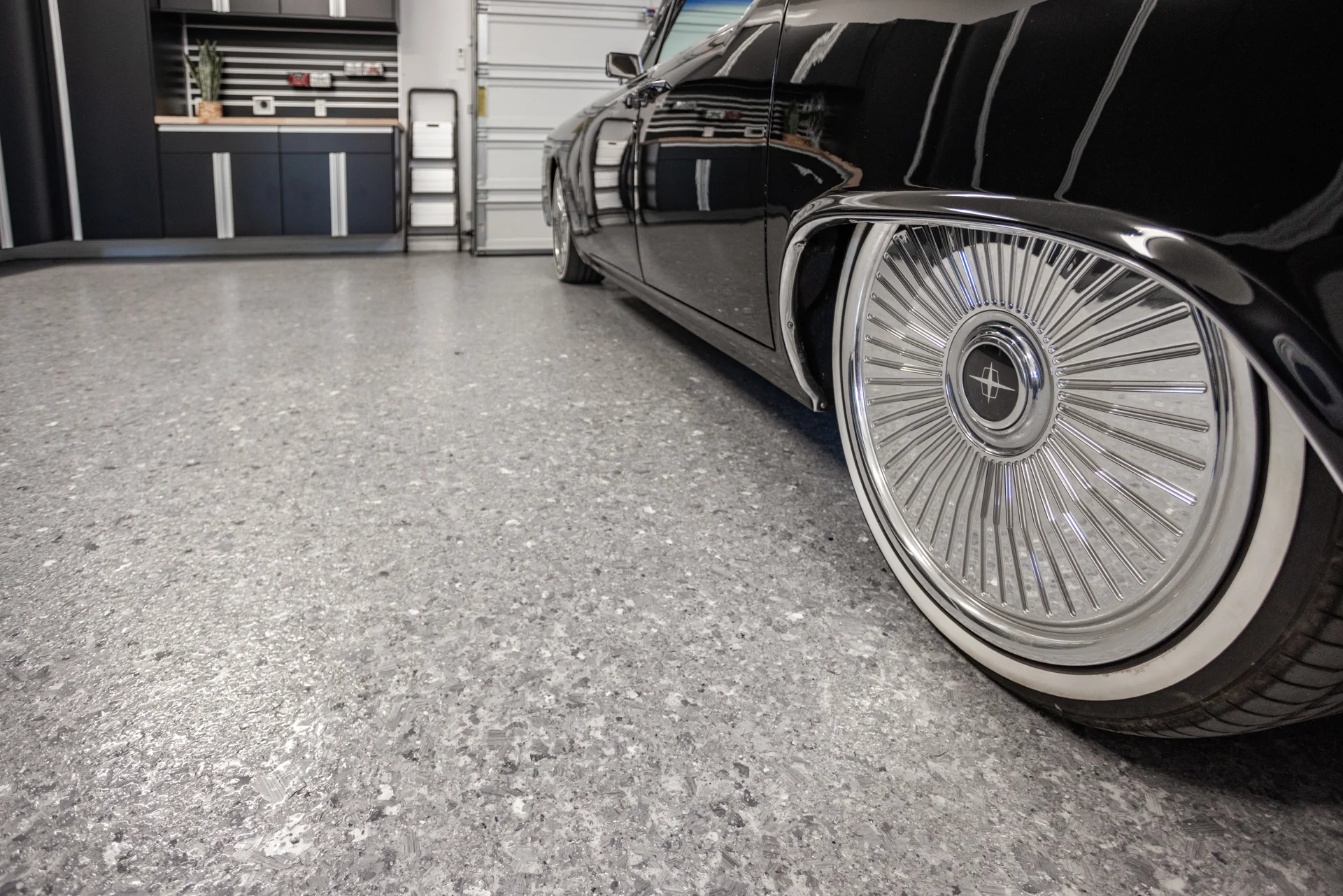
Professional installers use thicker, higher solids materials, paired with a stronger topcoat. For example, the Garage FX® system from GarageExperts® uses an industrial epoxy base coat, a layer of flake in the middle, and a polyaspartic topcoat. The polyaspartic topcoat adds durability and helps the floor resist UV fading, chemicals, and hot tire pickup.
A finished professional epoxy system is thicker than what a DIY kit produces, which is part of why it lasts longer.
Surface preparation
Preparation is the most important part of any epoxy floor. This step determines whether a coating bonds long-term or starts peeling early, and it's also the hardest part to get right on your own.
DIY epoxy kits usually rely on acid etching, which typically means a bottle of acid wash and instructions to clean the floor. You apply the solution, scrub, rinse, and let the floor dry. Etching can roughen the surface slightly, but it's less consistent, and it doesn't remove oil, old sealers, or past coatings. Any leftover residue or moisture can keep the coating from sticking, so the floor can fail in patches even when the product itself is fine.
Professional epoxy installers prepare the concrete by mechanically grinding the surface and repairing cracks, joints, and imperfections, vacuuming up the dust as they work. Grinding cleans the surface, opens the concrete's pores, and creates an even profile, so the coating can grip and fuse into the slab. This is a big reason professionally installed epoxy floors are less likely to peel, chip, or bubble over time, the way DIY floors often do.
Installers also check the slab for moisture, since excess moisture can keep a coating from curing properly. They fill cracks and smooth out low spots before any coating goes down. Skipping or rushing this step can cause a brand-new epoxy floor to start lifting within months.
That extra level of preparation is a big reason professional epoxy garage floors tend to last longer.
The application process
How the coating is applied matters as much as the product itself.
A DIY epoxy kit is a hands-on weekend project. You mix the product yourself, work quickly before it starts to set, roll it out as evenly as you can, and scatter the flake on by hand. Most kits include just enough flake to sprinkle lightly across the surface. Curing can take several days, and the floor needs to stay clear of foot traffic and vehicles during that time. Small mistakes in timing or mixing can leave roller marks, thin spots, or an uneven flake pattern.
A professional installation is usually done within 1 to 2 days by a trained crew. The crew mixes the product to the correct ratio, applies the base coat, broadcasts the flake until the floor is fully covered, and seals it with the topcoat. A full-flake broadcast gives the surface an even appearance and adds texture underfoot.
Because the crew controls each layer and the timing between coats, the floor comes out consistent from corner to corner. A polyaspartic topcoat also cures faster than most DIY epoxy, so the floor is usually ready to use again sooner.
Here's how the two approaches generally compare:
- Materials: DIY epoxy kits use thinner, lower solids coatings. Professionals use higher solids epoxy with a polyaspartic topcoat.
- Prep: DIY epoxy kits use acid wash. Professionals grind the concrete with machines and repair cracks and moisture issues first.
- Flake: DIY epoxy Kits give you enough flake to sprinkle on. Professionals broadcast flake to full coverage.
- Timeline: DIY projects take a weekend plus curing time. Professional installation can be finished in 1 to 2 days.
- Finish: DIY results depend on your skill and conditions. Professional results are more consistent.
Color and finish options
This is one of the clearest differences between the two options.
Most DIY epoxy kits come in a few neutral colors, usually gray, tan, or beige, with a small bag of flake to sprinkle on. You get a finished floor, but not much say in how it looks.
Working with a professional epoxy garage floor installer gives you more options. You can pick from a wider range of colors and flake blends to fit how you use the space and the look you want, whether you're going for a clean garage look or a busy workshop.
The Garage FX system from GarageExperts comes in over 140 colors, flake blends, and finishes, so you can match the floor to your space and pick the look before work starts. The flake is broadcast into the base coat and sealed under the polyaspartic topcoat, so your color and finish are built right into the floor.
Durability and how long each one lasts
This is where most people feel the difference.
A DIY epoxy coating can look great at first and hold up well in a low-traffic garage for a while. But because the coating is thinner and the prep is less thorough, it's more likely to peel, chip, suffer hot tire pickup, and wear down in the spots you use most. In a home garage with regular use, many DIY epoxy coatings start showing real wear within 1 to 3 years.
A professional epoxy system is built to handle daily driving, dropped tools, temperature swings, and regular cleaning for years. The thicker coating and stronger bond are what carry that durability. A professionally installed epoxy system with a polyaspartic topcoat typically lasts 15 to 20 years or more, though the actual lifespan depends on the prep, the amount of traffic the floor sees, how you maintain it, and your climate.
Warranty and who carries the risk
With a DIY epoxy kit, you carry all the risk. If the floor peels, bubbles, or cracks, the time and cost to fix it falls on you, and a redo usually means grinding off the old coating before you can start over.
Most professional epoxy floor installations come with a warranty, so issues with the coating or workmanship are covered.
At GarageExperts, we stand behind the quality of our Garage FX flooring system and the expertise of our team, which is why we back our residential floors with a limited lifetime warranty.
The cost, time, and value
A DIY epoxy kit costs less upfront and lets you work on your own schedule. For a budget-minded homeowner who enjoys hands-on projects and has a low-traffic garage, it can be a reasonable choice.
A professional installation is a larger upfront investment and includes materials, prep equipment, labor, and usually a warranty. The value shows up over time, in a floor that resists wear, needs less maintenance, and is far less likely to need a redo.
If a DIY epoxy floor fails early and has to be redone by a professional, the total cost can end up higher than starting with a professional install.
Maintenance and everyday care
These two options also differ in how much maintenance is needed.
A thinner DIY epoxy coating can be more sensitive to strong cleaners, spills left sitting, scuffing, and worn or chipped spots may need touch-ups sooner. Once a DIY epoxy floor starts to lift, it's hard to patch cleanly, because fresh coating doesn't bond well to a failing layer.
A professional epoxy floor is easier to live with. Day to day, it usually takes nothing more than sweeping and the occasional mop. The polyaspartic topcoat helps it shrug off spills, road salt, and cleaning products, so it keeps its finish with less effort. If you want a non-slip texture for a workshop or a floor that gets wet, that can also be added during installation, depending on the company.
How to decide what's right for your garage
Here are a few questions to help you choose:
- How much traffic does your garage see, and do you park heavy vehicles on it?
- Are you comfortable grinding or etching concrete and working within a timed application window?
- Do you want a warranty on the finished floor?
- How long do you want the floor to last before you think about it again?
If you're mostly looking for a quick way to upgrade your garage and you're comfortable taking on a hands-on project, a DIY epoxy kit may be enough. Just keep in mind the results can be inconsistent, and it may not hold up long-term.
If you're investing in your home or workspace and want a floor that looks great and lasts, professional epoxy garage flooring is worth considering.
Need help deciding what's right for your garage? Contact GarageExperts® today!
If you're still weighing your options, we'd love to show you the difference in person. At GarageExperts, we install our Garage FX floor coating system using full concrete grinding, complete flake coverage, and a durable polyaspartic topcoat, all backed by a limited lifetime warranty.
We'll walk through your garage with you, talk through colors and finishes from our 140+ options, and answer your questions with a free on-site estimate, with no pressure and no obligation.
Contact your local GarageExperts team to schedule yours today.